pull down to refresh
Yes, It's a serious feature. I am saying that it is worse as most devices fail on support blockers that come even earlier on the 'chain' of requirements to support, if you'd like to call it that. Many modern flagship phones have MTE, often unused with exception of iPhones but far more phones don't even allow installing another OS first off. Hope that explains what I was saying there.
With Qualcomm implementing working MTE into their processors (this being the second generation they have MTE, but previous gen was buggy) it is more likely potential devices could appear from other companies thanks to it. MTE isn't much of a blocker unlike device manufacturers completely blocking you out of running another OS like Samsung. Those are the worst offenders.
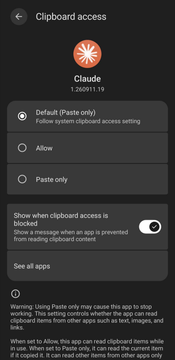
You can now control the clipboard access of applications individually in GrapheneOS. This makes apps only able to see data if the user manually pasted it, with an exception for clipboard items originating from the same app attempting to paste it. You can go into Settings -> Security and Privacy in…
Amber Final GrapheneOS Foundation Community and Support final at GrapheneOS dot org Matrix: @f1nal:GrapheneOS.org Stacker News: @final (https://stacker.news/final) Nostr: see verification Verification at my current Nostr npub below:…
I can think of many problems but here's a cut of just three I was arguing about.
Most OPSEC spaces recommend average Linux distributions as private and secure operating systems when they are not really doing anything leading in either front. Many also move security backwards, like Debian and derivatives freezing updates for applications. It ends up with these choices being decided by people saying "It is not Windows or Mac" rather than saying "It is more private and secure than the other [distributions]".
Secureblue is the closest I think exists for Linux right now, but it is quite different from what most Linux users would expect from daily use experience and also novel. I think if we're going all-in then OSes would leave Linux entirely.
I am aware Qubes OS exists but Qubes OS is simply a hypervisor running, again, average Linux distributions as virtual machines. Create an operating system designed around privacy/security first and you'll add extra defences to Qubes OS through more secure virtual machines as well.
This more secure distribution would then downstream into allowing more secure XMR nodes to be hosted, web servers, other services...
It's a really personal thing but I think we can make something better than Thunderbird that is just as functional while also being much smaller. I want to have a low attack surface email client. A lot of other competitive email clients don't have the same scrutiny and usage and are made with languages I don't like.
I think with the increasing attacks on individuals known to possess hardware signers, I think it is good to work harder on having secure wallets in devices that appear less suspicious, like phones. They're in no way made to replace cold storage, but alleviate risks.
I say 'cryptocurrency' because many are guilty of this, but you can think XMR, BTC, whatever here.
A lot of wallets that have leading cryptocurrency feature support are often made with weird language/stack decisions I hate. They make great references for the cryptocurrency's features but they do not make good wallets or mobile apps. They can have poor performance, UX and worse lack distinct security and privacy features.
I like Cake Wallet, but I don't like it enough. It feels odd to use at times, this is solely a personal preference. ZEUS is a leading Lightning wallet/node app but it's made in TypeScript and I find it very slow to use compared to the custodial Phoenix Wallet which is made with native Android libraries and Kotlin and is fast.
Developer stagnation is an issue, Samourai Wallet was mostly the same legacy Java codebase with years for major features to come, and I don't see much changes in Ashigaru either. A lot of XMR-only wallet apps are stagnant with exception of Monfluo which has several improvements open in the issue tracker.
For Android/GrapheneOS, if someone made a single or multi-wallet with Kotlin, mostly native libraries and UI, it would make a killing. Would also ensure compatibility with various exploit protections in GrapheneOS too.
My killer checklist would be: