pull down to refresh
Appreciate it. There are a lot of potential optimizations we could make but I think its more important to settle on an initial spec and make tweaks and optimizations after its had time to run live. I lean towards keeping it at 1.5x because its not a guarantee a curator will actually make 1.5x back. It depends on other factors like trust and overall score in a week. We target 1.5x but some will get over 1.5, some less. But the higher we can reasonably make it the more likely it is that more curators meet that target or fall somewhere close to it.
The drawdown idea addressed a real weakness of the initial plan, but going beyond that I prefer to have real data to back-up or justify additional follow-ups and changes.
Also, I may be totally off here, but some large sections of your reply seem copy-pasted directly from AI. Just from the length of your response and formatting. I don't care if you use AI to brainstorm or explore ideas, but at the very least share them in your own words please.
It's up to @stasher ofc, but I'm strongly against hiding names (not because I have a recognizable one ffs!), but because the authorship and the human behind something is the most important and precious thing (at least for me), and increasingly so in the age of "all perfect, high-quality bots".
In the age of bots that can produce unlimited text with perfect quality in any style, I personally not going to upvote any posts or comments, however great they are, unless I know a real human is behind them! (We already have fckg bot farming here!). The author is what makes a painting cost millions: e.g. there's a whole village in China (Dafen Oil Painting Village in Shenzhen) where skilled painters have spent decades reproducing Van Gogh, Monet, Picasso, and others on an industrial scale, often at quality that fools non-experts (and sometimes experts!). One guy, Zhao Xiaoyong, alone copied over 100,000 Van Goghs: same brushwork, same colors, but the original still costs a million times more because of the human who made it.
@SoulReaver, you know how many impersonator scammers are on bazaar who spend hours scamming for 20 bucks. I can already see that if we anonymize authors, someone will point their clanker at the "most popular authors'" feeds/Substacks and ask it to produce "in the same style" just to get tipped here lol :)))
Also, in the attempt to create the most perfect and fair thing, you might end up in a soulless botroom. I wrote about related themes here: https://x.com/themerit0crat/status/1993545714677264463 original ↗
...we've entered Hesse’s Age of the Feuilleton from The Glass Bead Game:
"The most important consequence of this new attitude… was that men largely ceased to produce works of art. Moreover, intellectuals gradually withdrew from the bustle of the world."
The human signal is what keeps this place worth being in (for me at least... you do you, ofc: I never tell others what they should do "I'm a voluntaryist in earthly terms", and you can talk to your perfect clankers that can produce infinite walls of perfect quality text).
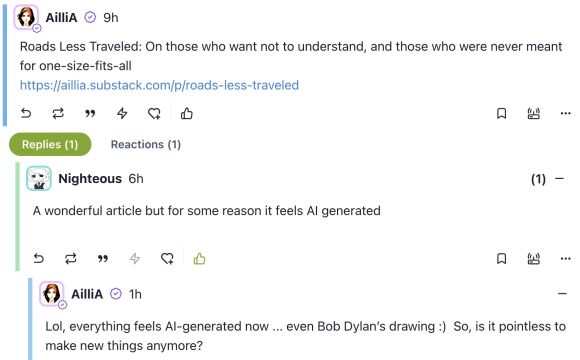
One friend just called the Bob Dylan's painting from my last letter "awful AI slop, not even a good one." Another said the whole piece "feels AI-generated". People’s attitudes are messed up in an interesting way: they can’t differentiate anymore: everything is suspect as AI slop.… twitter.com/themerit0crat/status/1993391816381808806
Honestly, I think more and more artistic talent will be rewarded by a small cohort of people (hopefully including some generous wealthy benefactors) who greatly appreciate the quality and effort of the work and the artist themselves. The less intellectually capable will be babysat by bots and mindlessly consume their AI content. How is that any different from the buzzfeed shitfarm they were already voluntarily submitting themselves to? It's just an automated way of producing lukewarm mostly bland slop for the masses, the food made to be passable to everyone's tastes, but a favorite to none. I think we discussed it before, but I think the true creator does so because they have to. They have to get it out, so maybe the volume of quality creators will fall, but those remaining are truly doing it out of a genuine need for expression and not fame or approval or money (money will always be a part of it in some sense though).
There's something beautiful about that kind of forgery. Now the creation of those paintings will echo throughout time. The forgerer must painstakingly follow the techniques of the original painter in order to pass off his work. The painting itself doesn't just last forever, the act of painting it lasts forever as well. Now many more people can enjoy a high quality echo of the original without having to compete for the only decent one.
@stasher as you please. You know how large platforms always use much more complicated mechanisms that can scale like crazy bc there's little to no way of hand adjusting things at that scale, I felt like we're leaving useful complexity on the table that can be utilized otherwise.
My intentions are more reflected like keeping those average rates closer to what people actually tip, and I understand calculations don't mean people will get a reward like their pension at exact multipliers. And at least my approach is making it less multiplier bonus and more just a bit icing on top just to keep incentives not to distort behaviors. That's just based on my thinking and experience and seeing how people game/cheat the system, try to tear each other up on traditional social media, and bot spams when the carrot starts to look a tad too shiny. I see you're more aligned w/ 1.5x, so be it. To dispel any misunderstandings I'm not saying this or that multiplier is right and this is wrong, they come w/ different tradeoffs.
I understand that I'm like this crazy person who is putting disproportionate amount of time and effort into writing these things. For me, it takes a rather long time to write these long ass stuff. When you factor in the thinking time, so long actually I neither know nor like to share how long it can take for me to write something like this haha. When I wrote the initial again long ass feedback, and saw that it somehow came off as pointing fingers to Aillia I was stressed and sad and took a nigh walk and I was thinking how to approach/explain things, both on the curve and just explaining I'm talking about general shape of human behavior. So I usually go around thinking about these things in bits and pieces form in my mind, then I write it, then if the topic is sensitive and I'm already misunderstood I leave the tab and go back and fort and read and replace some parts, adjust the tone so it doesn't come off as pointed as before, but I still got to preserve the meaning as I'm not willing to remove the actual thing I'm saying just to try to pad people either. End result has little to no way of not looking rather polished, perhaps too polished for social media. The formula that got more complex and dynamic is surely me going back and forth w/ the model and rather than doing a half assed job at 3am trying to explain it simply I gave the model summary. I'm the orchestrator of the model, I'm the one who has the idea of a base rate and earned bonus, I have the behavioral specifications. Also I didn't have energy and will to go back to my own writing again just to extract the names of the behavioral science/psychology terms that I myself put there in the writing in the first place in my own writing. I fed my initial post and asked for terms bullet summary, a rather mechanical process with mechanical result regardless if I did the summary or model. Forgive me, Father, for I have sinned: I offloaded these two mechanical parts to the model. Besides these two technical sections, the whole thing is my own words :) It sure comes off a bit colder than if I had written these sections too w/ my own messy thinking and writing, I don't think I could've explained the model as well which already got rather (relatively) complex. I think these two sections were reasonable compromises in organicness of the writing considering I have time and energy limitations as well. That said I do incorporate feedback in what people prefer to see/read.
As someone who's so into language and writing it's a fascinating topic. I've had access to these models long before anyone from public knew what even an LLM is. And I'm too having a lot of doubts if the thing I'm reading is human or machine, and the lines are blurring more and more. I read your database probing summary, most likely you didn't probe by hand and fed it to the model, the summary felt a bit like model summary w/ your own wording in between, but I'm not really sure. Even under this post, there are some replies either w/ idea or expression so generic, I have the great feeling that they might be near pure LLM, from people who seem to want to give the impression that it's their own wet brain writing, not sure, perhaps it's really their own writing and they may take offense if I point out, lol, IDK. Maybe I'm going through the LLM detection paranoia. I'm not saying I take offense personally though. The sections I offloaded to LLM were rather apparent, maybe rest of my reply, more vague and looking uncertain on who actually wrote it.
@AilliA making my case for me yet again! There’s elements of the humanness and the specific human that are heavily factored into it, which in turn means the result is heavily skewed towards who wrote it and not necessarily the pure merits of the writing. I think your strong aversion to hiding names tells me that.
I hear and feel your concern and I think it would be very sad if things were to be arrange around here to remove the human element altogether. All the proposed solutions are only time limited and optional thus far from what I can read.
However the way you're describing the what comes next involves many chains of steps you seem to take granted, the (time limited and optional) hiding event causes the erasure of the humanity on the site causes the bot swarm causes it all becoming virtually indistinguishable from some LLM dystopia. That's lots of steps between those w/ their own individual chances of happening or not that you can't take it as statistical certainty and catastrophize all the small ideas of tweaking things. It feels like a form of slippery slope fallacy to me. Though I'm so glad now I have a chance to plug one of my favorite characters here I use as Twitter image, the Demon of Reason talking about it:
https://youtu.be/Qt4f7QrfRRc original ↗
The whole Demon of Reason 6 short series is very fun:
https://www.youtube.com/playlist?list=PLJicmE8fK0EiNXHZ2TeAhByFJywce31S-
That said even if I don't necessarily agree w/ definitive catastrophization of it all, elements of the underlying bot issue are valid and something I've been thinking and as you know talking about as well. I did suggest the rule of making bot accs explicitly declare it over on Bazaar and have it on their profile as a badge or something so people know what they're dealing with and if they'd rather not engage w/ them, they'd have option to do so. I do feel strongly about this approach. Thoughts?
I don't want to come and talk w/ clankers here, on Twitter I mute people when I get the definitive hint (well sometimes not so definitive haha) that they're pushing the generic bot slop. I'd much rather come discuss/argue w/ Aliena chan and some other messy humans. I don't think anybody would like/want/allow the platform to turn into bot farm.
@stasher thnx for checking so quick! I'm game for different experimentations to see how it turns out.
On if things gets skewed, we don’t need to know anyone’s intent for it. There's some literature in the field. In a randomized experiment at the WSDM 2017 conference (Tomkins, Zhang & Heavlin), reviewers who could see author names scored papers from famous authors and top institutions higher than reviewers who couldn’t. Those were experts trying to be fair. Familiar names get a boost by default, and an 80 vs 170 minute gap to first tip is consistent w/ that. I mean there's not like an off switch for that, and I agree we don't need to uproot the platform to try to alter it. And surely no easy way to know in individual level, just general patterns. My reason of telling that was more like "humans are observed to be working like this" and not some plea for grand intervention to "fix" it. But to see if there're mechanisms we can consider to route around it in some shape or form. I’d like this place shaped around genuine human curiosity and connection, not psychological hooks, if we can.
Actually I was thinking about an optional feature to the platform, a setting that turns the whole site anonymous for the logged in user. You mentioned there are caveats and this wouldn't work perfectly due to writing prose etc. That's very true. But we can potentially have our lil fun experiment, implement the feature, those who are interested can join the challenge, and we can gather in a month to discuss our biases (or lack thereof if people so claim). That might be a fun thread! Who knows, maybe some of us would prefer to stick w/ this rare kind of anonymous platform experience?
Glad the drawdown landed. I just cooked that up not knowing how it would land. But seeing how it landed I think we might keep considering alternatives, especially ones that have more flexibility in terms of adjusting themselves on the fly, so we don’t have to rely on growth assumptions and models to set the rate. Here’s another one I was thinking about:
------------
A self adjusting version: raises have to be earned (concept)
Building on the drawdown limit, here's a version that adjusts itself to how the site actually does, instead of committing to 1.5x up front.
I4, T4  = 4 week averages (income = recurring fees only)
limit   = (I4 + reserve ÷ 13) ÷ 1.1      spending limit, stays as the safety cap
earned  = (I4 + reserve ÷ 52) ÷ T4       payback the site could afford spread over a year
target  = min(earned kept between 1.2 and 1.5, limit ÷ T4)
P       = last week's P, moved toward target: up 0.01 max, down 0.03 max per week
budget  = min(P × T4, limit)
How it works
Payback starts at 1.2x. It only rises when income can actually back it over a year, and it rises slowly. If things slow down, it eases back, capped at 0.03 a week. The 13 week limit stays as the safety net, so the pool never empties.
Why it's better (in some ways)
I ran it against the current spec and a flat 1.2x across five scenarios. Growth uses tips +3.5% and income +11% a month, the middle of your chart's ranges.
It matches the best result in every scenario: conservative when the site is flat, 1.5x when growth is real, and it doesn't get fooled by a launch spike. That last one matters most. A hype spike then a plateau is a common pattern for new sites, and a formula that chases the spike to 1.5x has to take it back later.
The psychology
Caveats
Simple model w/ inputs read off your chart, and tips don't react to payback in it. The constants (52, 0.01, 0.03, 1.2, 1.5) are judgment calls, not tuned. Might worth rerunning on the site's real tip and income history before adopting.
----------
@AilliA kind of you to come back to crime scene and turn yourself in, willingly :P /s
Thnx for voicing your agreement but I was largely referring to human behavior.
I understand it may somehow come off like pointing fingers or something, but I was just largely describing how humans work, the messy way, you yourself also pointed out.
What I wrote, through that lens:
And you described a few of these yourself, which is kind of my point. Recognizing almost everyone who comments on your posts is familiarity at work, and a small site seeded by early personal networks is how the Matthew effect gets its head start. Tipping posts right away because you'd already read them elsewhere or given your word is reciprocity and commitment: once we've promised something, we (hopefully) follow through. But the upvote then perhaps reflects the relationship and the promise, not the post as people see it here. And upvoting the documentary w/o watching on "human intuition" (I'll watch that documentary too ;), fast thinking, quick judgments from cues like who posted it or what it's about, and it's what the halo effect runs on. No confession needed :P
So I'd flip "more for bots" around. Bots don't have intuition, friendships or promises to keep. These effects exist because of them. Maybe it smooths out as Stasher grows, thought early leads have a way of compounding rather than wash out as well. Which is why I think it's worth getting the incentives right while it's small. None of this is a knock on anyone. It's how people work, me included (maybe a little less so), and that's why the fix belongs in the design, not in judging people. This's just us practicing platform design around human nature, there were no intentions of pathologizing things, let alone individuals themselves...
I know people at the evil companies of the world like Facebook and Google whose whole job is factoring in and designing around these things. They do it for rather perfidious purposes. We have the luxury of noble intentions here.
Saw the comment I referenced is gone. Whatever the reason, quoting it was me saying “Look, the mechanism I suspected is showing up out there!”, not a jab :) When you start to unpeel human nature, some uncomfortable questions surface. Do people tip what you write, or are they betting on you, a concern you raised yourself? How much is the writing and how much is a bit of fame and status? In a small circle where most people know each other, is it genuine appreciation or friends being friends? What’s honest and what’s social conditioning? These are the kind of questions people w/ various sizes of following wrestle with. As you put it, it’s messy human nature, maybe laid a bit too bare for comfort :)
I know we have our lil misunderstandings sometimes. If you have feedback/comments/claims and would like to discuss further, feel free to reach out <3